The Cognitive Architecture of Safety Learning.
How XR2TRAIN's four-tier framework applies cognitive science to produce training that changes behaviour, not just knowledge.
Strategic Authority
With strategic input from Dr Peter Hughes, Strategic Board Member, XR2TRAIN
XR2TRAIN | IkigaiXR Group · 2025
IOSH Approved · CITB Endorsed · Hinkley Point C · Sellafield

Executive Summary. Why Most Safety Training Fails Before the Learner Leaves the Room
There is a well-established body of cognitive science that explains, with considerable precision, how human beings acquire knowledge, convert it into skill, and retain it under pressure over time. This science has been available for decades. It is taught in every educational psychology programme in the world. It has been applied systematically in military training, medical education, elite sport, and aviation. It has been applied almost nowhere in occupational safety training.
The consequence of that gap is not abstract. It is the persistent, documented failure of safety training to produce the behavioural change it is designed to produce. Workers who can pass an assessment and cannot apply what they have learned six weeks later. Procedures that are followed in training conditions and abandoned under operational pressure. Hazards that are recognised in a classroom scenario and missed on a live site. These are not failures of worker intelligence or motivation. They are failures of instructional design — the predictable result of delivering training that was not built around how the brain actually learns.
XR2TRAIN was designed from the outset to close that gap. Not by adding technology for its own sake, but by applying a coherent, evidence-based cognitive framework to every tier of the learning experience — from foundational awareness content through to full immersive extended reality deployment. The result is a four-tier architecture in which every design decision, every interaction, every transition between modalities is grounded in a specific and defensible understanding of what the brain needs to learn effectively.
“The question is never whether training was delivered. The question is whether learning occurred — and whether that learning survives contact with the real world.”
The framework draws on the established work of cognitive scientists including John Sweller, Benjamin Bloom, Richard Mayer, David Kolb, Hermann Ebbinghaus, Lev Vygotsky, and Allan Paivio — applied specifically to the demands of high-hazard industrial training, and validated through operational deployment in some of the most safety-critical environments in the UK.
Part One: The Cognitive Science Foundation. Eight Models, One Architecture
Cognitive learning science is not a single theory. It is a body of interconnected research, developed across more than a century, that describes the mechanisms by which information is processed, encoded, stored, and retrieved by the human brain. Different theories illuminate different aspects of this process. Used in isolation, each is partial. Used together — mapped to the specific demands of each learning modality — they form the basis of an instructional design framework that is substantially more powerful than any single model can produce.
XR2TRAIN's four-tier learning framework draws on eight established cognitive models. Each is described below. Subsequent sections of this paper explain how each model is applied within specific tiers of the framework, and why that application is appropriate to the cognitive demands of that tier.
Bloom's Taxonomy — The Architecture of Learning Objectives
Benjamin Bloom's taxonomy of educational objectives, first published in 1956 and revised in 2001, provides the foundational scaffolding for the entire XR2TRAIN framework. Bloom identified six levels of cognitive engagement: remembering, understanding, applying, analysing, evaluating, and creating. These are not simply a list of increasing difficulty. They describe qualitatively different cognitive operations — the difference between knowing that a confined space requires atmospheric monitoring and being able to analyse a novel atmospheric reading and make a correct entry decision in real time.
The taxonomy matters because most conventional programmes operate almost exclusively at the lower two levels. The higher-order operations — application, analysis, evaluation — are where genuine competency lives.
Managing Working Memory. Processing Multiple Channels
Cognitive Load Theory — Managing Working Memory
John Sweller's theory identifies the limited capacity of working memory. When that capacity is exceeded — when the learner is simultaneously processing too much new information and managing emotional demands — learning breaks down. Sweller distinguishes between three loads: Intrinsic load (inherent complexity), Extraneous load (unnecessary burden from poor design), and Germane load (productive effort that drives learning).
Effective instructional design minimises extraneous load and maximises germane load. Every design decision in the XR2TRAIN platform — from e-learning structure to XR scenario complexity — is evaluated against this framework.
Mayer's Multimedia Learning — Processing Channels
Richard Mayer established that the brain processes verbal and visual information through separate channels. When coordinated — when narration describes exactly what a diagram is showing — learning is enhanced. When misaligned — when text duplicates spoken narration — cognitive channels are overloaded and learning is impaired.
Mayer identified twelve principles of effective design, including coherence, contiguity, and segmentation. These are evidence-based design requirements, not stylistic preferences.
Learning Through Doing. The Enemy of Retention
Kolb's Experiential Learning Cycle
David Kolb describes learning as a four-stage cycle: concrete experience, reflective observation, abstract conceptualisation, and active experimentation. Genuine understanding requires embodied experience followed by structured reflection. In XR2TRAIN, concrete experience is provided at upper tiers via immersion, while abstract conceptualisation occurs in foundational e-learning. The framework ensures all four stages are completed, rather than left partial as conventional training frequently does.
Ebbinghaus Forgetting Curve — Spaced Repetition
Hermann Ebbinghaus established that without reinforcement, the brain forgets the majority of new information within days. For safety training, the implication is uncomfortable: a worker who completes a course once a year has forgotten most of it by the time of renewal. Re-teaching forgotten material is remediation, not education.
The evidence-based response is spaced repetition — learning encounters distributed over time, calibrated to the rate of forgetting.
The Scaffolding Principle. The Body as a Learning System
Constructivism & Dual Coding
Constructivism holds that learning is the active construction of new understanding built on existing knowledge. Vygotsky's Zone of Proximal Development describes the space where learning is most effective — between independent capability and provided support. Scaffolding is a design requirement for every XR2TRAIN tier.
Dual Coding Theory proposes the brain encodes info in two systems: verbal and imagistic. Info in both is more richly represented and reliably retrieved. This is the mechanism by which high-fidelity visual environments create high-fidelity memories.
Stress Inoculation & Embodied Cognition
Stress inoculation — deliberate exposure to realistic stressors — creates neural pathways that enable faster, more reliable responses in real life. Embodied cognition extends this: the body is an active participant in cognition. Physical engagement with a simulation creates a qualitatively different kind of memory than screen-based learning can access.
The activation of motor and emotional response systems consolidates memory in ways that classroom instruction cannot reach.
PART TWO: THE FOUR-TIER FRAMEWORK. Architecture by Design — How the Tiers Work Together
The XR2TRAIN four-tier framework is not a menu of options. It is a progressive cognitive architecture — a sequence of learning experiences designed so that each tier builds on the cognitive work of the previous one, addresses a distinct set of learning objectives mapped to Bloom's taxonomy, and deploys the theoretical models most appropriate to its modality.
The framework is designed to be future-proof. Theoretical underpinnings are stable; cognitive science has not been overturned in decades. Technological modalities will evolve (haptics, AI), but the architecture accommodates these developments because it was built on the science, not the technology.
Tier 1: Awareness E-Learning
Tier 1 focuses on foundational knowledge acquisition — Bloom’s levels of Remembering and Understanding. The design imperative is the management of cognitive load. Sweller's framework is the primary specification: managing intrinsic load through sequencing, minimising extraneous load through clean interface design, and maximising germane load via worked examples and analogies.
Content is structured in learner-paced segments (Mayer) and anchored to specific industrial contexts (Vygotsky).
Knowledge Application. The Cognitive Role of WebGL
Transitioning from Knowing to Doing
Tier 2 marks the movement to Bloom's levels of Applying and Analysing. The primary challenge is bridging the gap between declarative knowledge (knowing that) and procedural knowledge (knowing how). This is solved through interactivity requiring genuine cognitive engagement and the integration of WebGL environments as a spatial bridge.
WebGL is not decoration; it provides spatially accurate 3D representations that activate the imagistic memory system more richly than 2D graphics, building spatial schemas activated in the real environment.
Scaffolded Complexity
Vygotsky's Zone of Proximal Development governs sequencing here. Scenarios escalate in complexity, supported by hints and prompts that are withdrawn as capability develops. This AI-driven adaptive scaffolding ensures learners work at the edge of their current capability — too easy prevents schema building, too hard causes overload.
Learning is most durable when challenge level is accurately calibrated to current learner capability.
Evaluative Competency. Identity and Accreditation
Tier 3 is the formal accreditation layer, where work is assessed against IOSH Approved and CITB Endorsed standards. It operates at Bloom's Evaluating and Creating levels — distinguishing genuine expertise from trained compliance. Evaluation requires judgements on risk control adequacy; Creation requires synthesis of skill into novel responses to matched scenarios.
The assessment target is the cognitive work safe performance requires, not merely recall. Pre-assessment spaced repetition review ensures testing occurs at maximum knowledge consolidation.
Maslow and the Certification Layer
Attainment of a globally acknowledged qualification addresses Maslow's esteem needs. Formal accreditation represents a significant milestone in professional identity. A worker assessed against a recognised standard has a different relationship with safety than one who completed a mandatory module; the qualification becomes a cognitive anchor for safety behaviour.
Behaviours that conflict with this identity create cognitive dissonance, driving intrinsic compliance.
Tier 4: Immersive XR / VR. The Neuroscience of Mastery
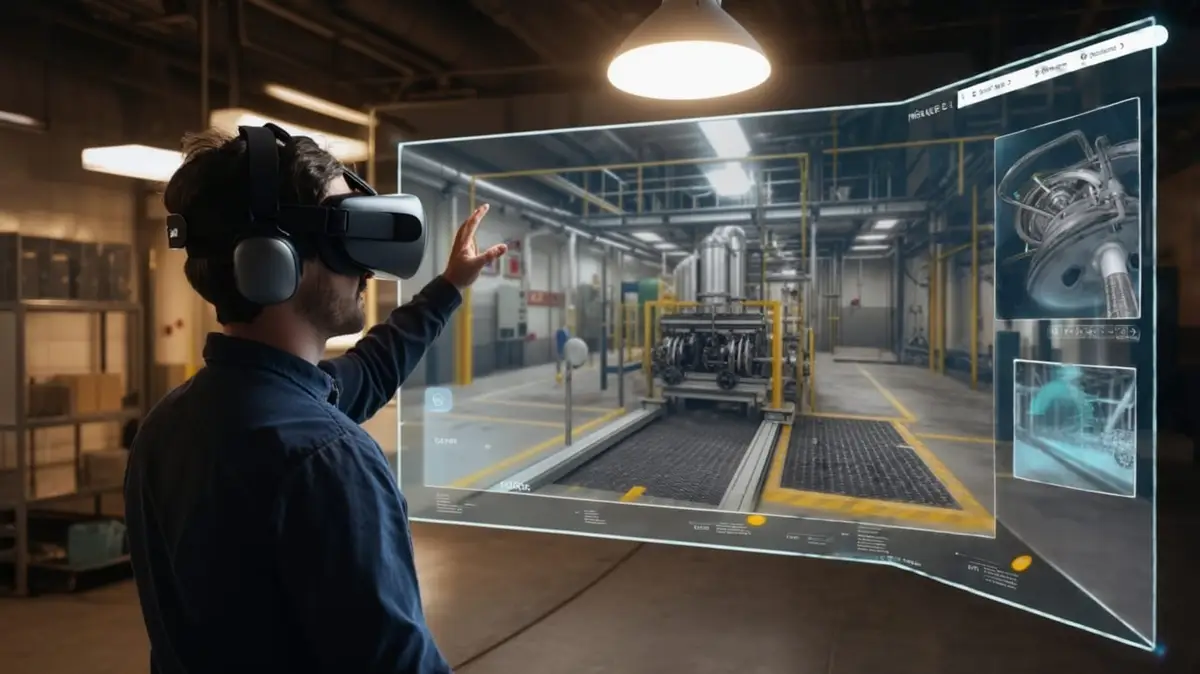
Tier 4 is the pinnacle because it is the only modality capable of activating the full range of cognitive systems procedural mastery requires. The rationale rests on three mechanisms: Embodied Cognition (motor and emotional response involvement), Stress Inoculation (reducing novelty of threats), and the completion of Kolb’s full cycle via immersive experience.
The brain does not fully distinguish high-fidelity simulation from real environments in terms of threat assessment. The amygdala and hippocampus create a procedural, emotionally encoded memory trace that the brain draws on instinctively under pressure.
The Structured Debrief
In XR training, the scenario is not the end; it is the beginning of a reflective process where principles demonstrated relate back to Tier 1 and 2. Without this cognitively essential stage, the experiential cycle is incomplete and full consolidation of procedural memory does not occur.
XR scenario design operates in the productive arousal zone to enhance learning without overwhelming the brain.
Part Three: The Integrated Framework. The Cognitive Golden Thread & The Role of AI
The Cognitive Golden Thread
Each tier of the XR2TRAIN framework is cognitively coherent in isolation. The value of the four-tier architecture, however, is not the sum of four separate learning experiences. It is the product of their integration — the way in which each tier builds on the cognitive work of the previous one, and the way in which the theoretical models applied across the tiers combine to address the full spectrum of cognitive operations that genuine safety competency requires.
The progression through the tiers is a progression through Bloom's taxonomy: from remembering and understanding at Tier 1, through applying and analysing at Tier 2, to evaluating and creating at Tier 3, to the simultaneous activation of all levels in the embodied, pressure-tested scenarios of Tier 4. This is not a coincidence of design. It is the structural expression of the most important insight in educational psychology: that genuine expertise is not more knowledge. It is knowledge organised differently — available for deployment at every level of cognitive demand, simultaneously, under conditions of real-world pressure.
“The four-tier framework builds a cognitive architecture in which genuine competency — the kind that holds under pressure — can actually develop.”
The Role of AI Across All Tiers
The AI component of the platform is not a feature of any single tier. It is the connective tissue of the entire framework — the mechanism by which the cognitive insights of each tier inform the design of what comes next for each individual learner. AI monitors performance across all modalities, identifies the specific knowledge and skill gaps that each learner carries from one tier to the next, adjusts the scaffolding and complexity of content accordingly, and manages the spaced repetition schedules that maintain retention across the full learning journey.
In cognitive terms, the AI component implements the adaptive scaffolding principle at scale. It tracks each learner's position within their Zone of Proximal Development as it shifts over time, and adjusts the learning environment to keep them working consistently within it. This is the practical expression of Vygotsky's insight that learning is most powerful when it operates at the edge of current capability.
Future-Proofing the Architecture
The framework is designed to evolve. The cognitive science on which it is built is stable. What changes is the fidelity and accessibility of the tools available to apply those mechanisms. Haptic feedback and neural interface technologies will open new channels for the direct measurement of cognitive load and arousal state, enabling real-time scenario calibration of a precision not currently achievable. These developments represent a deepening of the framework, not a departure from it.
Part Four: Authority and Validation. Scientific Rigour and Operational Proof
Dr Peter Hughes and the Evidence Base
The cognitive framework described in this paper is not a proprietary invention. It is an application of established, peer-reviewed science developed over more than a century. XR2TRAIN's contribution is the systematic, rigorous application of that science to a domain — high-hazard industrial safety training — in which it has historically been underdeployed to a degree that is difficult to justify.
The strategic oversight of that application is provided in part by Dr Peter Hughes, Strategic Board Member of XR2TRAIN. Dr Hughes brings internationally recognised expertise in cognitive learning science to the development and validation of the framework. His involvement reflects a commitment to ensuring that the cognitive claims made for the platform are grounded in the evidence base and applied with the rigour that the evidence demands.
Dr Hughes's work has been instrumental in bringing the insights of cognitive science to audiences well beyond the academic community. That communication work reflects a conviction that the science of learning is too important to remain the exclusive property of researchers. It belongs in the hands of the practitioners who design training and the workers who depend on it to keep them safe.
Operational Validation
The XR2TRAIN cognitive framework is not validated by theory alone. It is validated by operational deployment in environments that apply the most demanding real-world test of whether training actually works. At Hinkley Point C — Europe's largest active infrastructure project, where Bylor maintains safety standards that satisfy the Office for Nuclear Regulation — the platform delivers training where the consequences of inadequate preparation are not recoverable.
At Sellafield — the UK's primary nuclear decommissioning site — the same framework is applied to hazard environments of extraordinary complexity. These deployments are the operational proof of concept for the cognitive architecture. Not because they demonstrate impressive technology, but because they demonstrate that a system built on rigorous cognitive science can meet the competency standards of the most safety-critical industrial environments in the United Kingdom.
“The science of learning has been clear for decades. The question is whether we have the commitment to apply it.”
CONCLUSION. A Different Standard for Safety Training
The cognitive science of learning is not new. The theoretical models described in this paper have been available for decades. The research base that validates them is extensive, robust, and consistently replicated. None of what has been described here is speculative or experimental.
What is relatively new is the systematic application of this science to occupational safety training in high-hazard industry — and the availability of the technological modalities required to implement it fully. The combination of these two developments, brought together in the XR2TRAIN four-tier framework, represents a genuinely different standard for what safety training can achieve.
Not training that produces certificates. Training that produces competency — the kind of competency that is encoded at multiple cognitive levels simultaneously, maintained through spaced repetition, tested against realistic scenarios under appropriate pressure, and formally validated through globally recognised accreditation.
This is the kind of competency that holds when conditions are abnormal, when procedures require adaptation, and when the difference between the right response and the wrong one is measured in seconds. That standard is achievable. The science says so. The operational deployments confirm it. The question for any organisation responsible for the safety of a workforce in a high-hazard environment is whether it is prepared to hold its training to it.
Technical Contact
XR2TRAIN | Part of the IkigaiXR Group
Manchester · Mallorca · Dubai · xr2train.com
Registry Badges:
IOSH Approved · CITB Endorsed · Hinkley Point C · Sellafield